




Shopping Cart [more]
Index of Products
Information
- 9PTK Titration Instructional Videos
- Automatic Rinse Tank Controls
- Boiler and Cooling Towers
- Circuit Board Cleanliness Testing
- Deionized Water
- Environmental Applications
- Fountain Solutions
- Frequently Asked Questions
- Glossary of Terms
- Hemodialysis Applications
- Horticulture
- Hydroponics
- Material Safety Data Sheets
- Operation Manuals / Instructions
- Oxidation Reduction Potential (ORP)/Redox
- Pool and Spa
- Product Data Sheets
- Reverse Osmosis
- Technical Reference: Handheld pH Instruments
- Textile Manufacturing

Deionized Water
Years ago, high purity water was used only in limited applications. Today, deionized (Dl) water has become an essential ingredient in hundreds of applications including: medical, laboratory, pharmaceutical, cosmetics, electronics manufacturing, food processing, plating, countless industrial processes, and even the final rinse at the local car wash.
THE DEIONIZATION PROCESS
The vast majority of dissolved impurities in modern water supplies are ions such as calcium, sodium, chlorides, etc. The deionization process removes ions from water via ion exchange. Positively charged ions (cations) and negatively charged ions (anions) are exchanged for hydrogen (H+) and hydroxyl (OH-) ions, respectively, due to the resin's greater affinity for other ions. The ion exchange process occurs on the binding sites of the resin beads. Once depleted of exchange capacity, the resin bed is regenerated with concentrated acid and caustic which strips away accumulated ions through physical displacement, leaving hydrogen or hydroxyl ions in their place.
DEIONIZER TYPES
Deionizers exist in four basic forms: disposable cartridges, portable exchange tanks, automatic units, and continuous units. A two-bed system employs separate cation and anion resin beds. Mixed-bed deionizers utilize both resins in the same vessel. The highest quality water is produced by mixed-bed deionizers, while two-bed deionizers have a larger capacity. Continuous deionizers, mainly used in labs for polishing, do not require regeneration.
TESTING Dl WATER QUALITY
Water quality from deionizers varies with the type of resins used, feed water quality, flow, efficiency of regeneration, remaining capacity, etc. Because of these variables, it is critical in many Dl water applications to know the precise quality. Resistivity/ conductivity is the most convenient method for testing Dl water quality. Deionized pure water is a poor electrical conductor, having a resistivity of 18.2 million ohm-cm (18.2 megohm) and conductivity of 0.055 microsiemens. It is the amount of ionized substances (or salts) dissolved in the water which determines water's ability to conduct electricity. Therefore, resistivity and its inverse, conductivity, are good general purpose quality parameters.
Because temperature dramatically affects the conductivity of water, conductivity measurements are internationally referenced to 25°C to allow for comparisons of different samples. With typical water supplies, temperature changes the conductivity an average of 2%/°C, which is relatively easy to compensate. Deionized water, however, is much more challenging to accurately measure since temperature effects can approach 10%/°C! Accurate automatic temperature compensation, therefore, is the "heart' of any respectable instrument.
RECOMMENDED INSTRUMENTATION
Portable instruments are typically used to measure Dl water quality at points of use, pinpoint problems in a Dl system confirm monitor readings, and test the feed water to the system. The handheld Myron L® Company instruments have been the first choice of Dl water professionals for many years. For two-bed Dl systems, there are several usable models with displays in either microsiemens or ppm (parts per million) of total dissolved solids. The most versatile instruments for Dl water is the 4P or 6PFCE Ultrameter II™, which can measure both ultrapure mixedbed quality water and unpurified water. It should be noted that once Dl water leaves the piping, its resistivity will drop because the water absorbs dissolved carbon dioxide from the air. Measuring of ultrapure water with a hand-held instrument requires not only the right instrument, but the right technique to obtain accurate, repeatable readings. Myron L® Company instruments offer the accuracy and precision necessary for ultrapure water measurements.
In-line Monitor/controllers are generally used in the more demanding Dl water applications. Increased accuracy is realized since the degrading effect of carbon dioxide on high purity water is avoided by use of an in-line sensor (cell). This same degradation of ultrapure water is the reason there are no resistivity calibration standard solutions (as with conductivity instruments). Electronic sensor substitutes are normally used to calibrate resistivity Monitor/controllers.
Myron L® Company manufactures a variety of in-line instruments, including resistivity Monitor/controllers which are designed specifically for Dl water. Seven resistivity ranges are available to suit any Dl water application: 0-20 megohm, 0-10 megohm, 0-5 megohm, 0-2 megohm, 0-1 megohm, 0-500 kilohm, and 0-200 kilohm. Temperature compensation is automatic and achieved via a dual thermistor circuit. Monitor/controller models contain an internal adjustable set point, piezo alarm connectors and a heavy-duty 10 amp relay circuit which can be used to control an alarm, valves, pump, etc. Available options include 4-20 milliamp output, 3 sensor input, 3 range capability and temperature. Internal electronic sensor substitutes are standard on all Monitor/controllers.
Sensors are available constructed in either 316 stainless steel or titanium. All sensors are provided with a 3/4" MNPT polypropylene bushing and 10 ft./3 meters of cable. Optional PVDF or stainless steel bushings can be ordered, as well as longer cable lengths up to 100 ft./30 meters.
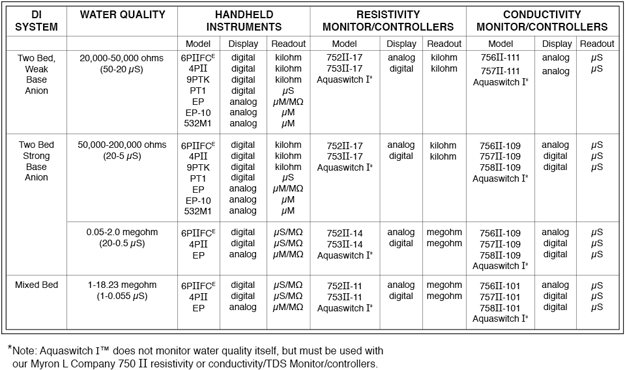
The following table briefly covers Myron L® Company instruments for Dl water applications. For details and recommendations, please refer to Myron L® data sheets.
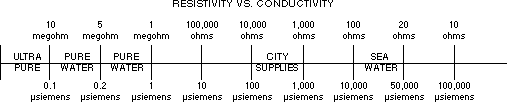
Useful Conversions:
1/megohm = microsiemens (micromhos)
1/microsiemens (micromhos) = Megohm
Examples: 1 micromho (μmho) = 1 microsiemen (μS) 0.5 microsiemens = 2 megohms (2,000,000 ohms) 200 kilohm (200,000 ohms) = 0.2 megohm = 5 microsiemens
Other products and companies referred to herein are trademarks or registered trademarks of their respective companies.
**Prices, images and specifications subject to change without notice.**


For your convenience, we accept these credit cards: